Open Call to the Inaugural Lorentz Center Workshop
2025-12-05
Open Call
- Date
- 14-18 September 2026
- Location
- Lorentz Center@omega, Leiden, The Netherlands
- Registration
- Register via the Lorentz Center workshop page
- Focus
- Use cases and evaluation on Monday; joint-representation model design for the rest of the week
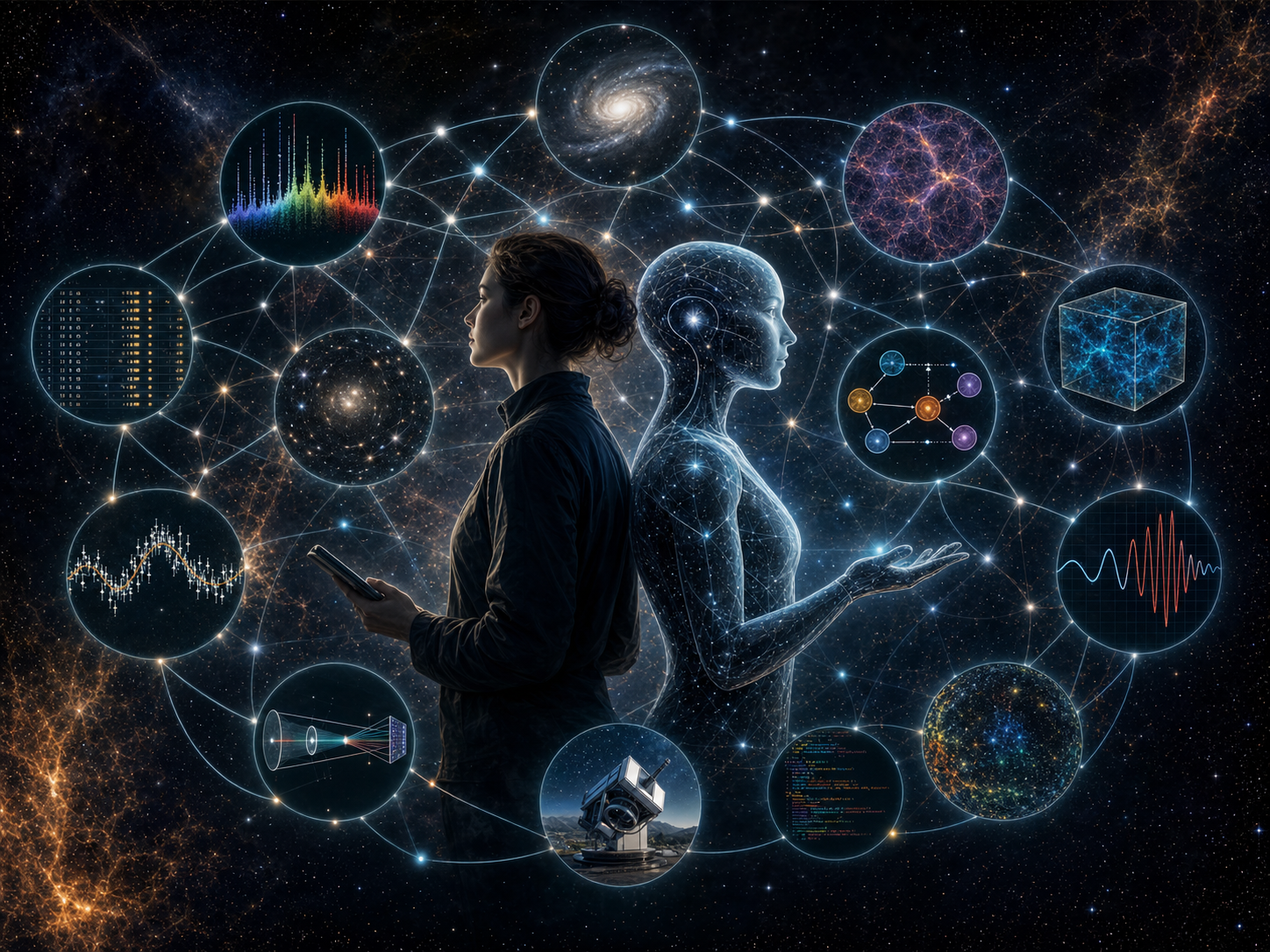
We are inviting participants to join a focused Lorentz Center workshop on building the scientific and technical basis for AI-accelerated astrophysical discovery.
Two pillars
The consortium has two connected goals. The first is to design Science 2.0: how future astrophysicists and cosmologists will study the cosmos in collaboration with AI. Humans ask the scientific questions, judge evidence, and decide what counts as discovery; AI systems can help retrieve, compare, simulate, and test evidence across archives that are too large for unaided human attention.
The second is to build a generative joint-representation model that allows reasoning models to understand heterogeneous physical data: images, spectra, time series, catalogues, simulations, instruments, code, and provenance. It should support embeddings for serendipity and retrieval, generative inference across linked observations and simulations, and agentic scientific workflows guided by human judgement.
Together, these pillars aim to accelerate serendipity: helping researchers notice rare objects, surprising analogues, missing context, and cross-instrument relationships they might not know to ask for.
The week will stay deliberately narrow. Monday will define shared vocabulary, flagship use cases, and evaluation targets. The rest of the week will focus on the joint-representation model: the relevancy graph, tokenisation implications, long-context architecture, training protocol, MVP scope, funding, and post-workshop roadmap.
Who should join
We are especially interested in contributors who bring:
- concrete astrophysical or cosmological discovery workflows;
- expertise in multimodal data, simulations, instruments, archives, or provenance;
- experience with representation learning, generative models, long-context systems, agentic AI, uncertainty, or evaluation;
- interest in open-source infrastructure, governance, funding, and sustained collaboration.
Expected outputs
By Friday we aim to leave with:
- selected use cases with explicit evaluation targets;
- a Relevancy Graph v0 for the required data relationships;
- an Architecture and Training Protocol v0 for the model;
- an MVP backlog, hackathon artifacts, and named owners;
- a consortium roadmap for funding, governance, and follow-up work.
Organizers
- Joshua G. Albert: California Institute of Technology; Leiden Observatory
- Roberto Ruiz de Austri: IFIC; CSIC; Universidad de Valencia
- Sascha Caron: Radboud University; Nikhef
- Francisco Villaescusa-Navarro: Simons Foundation
- Gabrijela Zaharijas: University of Nova Gorica
For logistics, registration status, and organiser contact details, use the official Lorentz Center workshop page.